The Shared Foundation of Vehicle History Reporting
In the complex and often opaque market of used vehicles, information is the most valuable currency for a prospective buyer. Two names have come to dominate the field of vehicle history reporting: CarFax and AutoCheck. Before dissecting their critical differences, it is essential to understand the foundational principles and operational framework they share. This common ground establishes the baseline capabilities and inherent limitations of the entire vehicle history report (VHR) industry, providing the necessary context to appreciate the significance of each service's unique value proposition.
Core Purpose: Illuminating a Vehicle's Past
At their core, both CarFax and AutoCheck serve the identical primary function: to provide a detailed historical record of a specific used vehicle based on its 17-character Vehicle Identification Number (VIN). The VIN acts as a unique serial number for every car manufactured since 1981, allowing for the tracking and compilation of major events throughout its operational life. The ultimate objective of both services is to arm consumers and dealers with crucial information, enabling them to make more informed purchasing decisions, identify potential red flags, and avoid unknowingly acquiring a vehicle with a problematic past. These reports have become an integral, if not indispensable, component of the modern used car transaction, serving as a first line of defense against hidden issues.
The Data Aggregation Model: A Common Ecosystem of Sources
It is critical to understand that neither CarFax nor AutoCheck are primary investigators; they do not physically inspect vehicles or generate original data. Instead, they are sophisticated data aggregators. Both companies operate by sourcing, collecting, and compiling vast quantities of data from thousands of partners and then presenting that information in a structured, consumer-friendly report. While the specific relationships and exclusivity of these sources differ—a point of major differentiation explored later—the types of entities they draw from are largely the same.
This shared data ecosystem includes:
-
Government Agencies: Departments of Motor Vehicles (DMVs) or Registries of Motor Vehicles (RMVs) in all 50 U.S. states, the District of Columbia, and all Canadian provinces are foundational sources for title, registration, and branding information.
-
Insurance Companies: These partners provide data on accident claims, particularly when a vehicle is declared a "total loss".
-
Auto Auctions: A significant channel for used vehicle sales, auctions provide data on transactions and, importantly, condition announcements made at the time of sale.
-
Service and Repair Facilities: A vast network of dealerships, national service chains, and independent repair shops report maintenance events, from routine oil changes to major repairs.
-
Law Enforcement: Police departments contribute information from accident reports and theft records.
-
Fleet and Rental Companies: Data from these sources helps identify vehicles that have been used for commercial, rental, or fleet purposes.
-
Manufacturers: Automakers supply crucial data regarding safety and emissions recalls.
-
Salvage and Recycling Infrastructure: Salvage auctions, junkyards, and auto recyclers report when vehicles are taken out of service or sold for parts.
Standardized Information Categories: What to Expect from Any Report
As a result of their similar data aggregation models, a user can expect to find a core set of information in any standard report from either CarFax or AutoCheck. While the depth and presentation will vary, these fundamental categories form the backbone of a VHR:
-
Title History: This is arguably the most critical section, detailing the vehicle's title status. It flags severe "brands" that can drastically affect a vehicle's value and safety, such as Salvage, Junk, Rebuilt, Flood, Fire, Hail, or Lemon.
-
Ownership History: The report will show the number of previous owners, the approximate length of each ownership period, and the states or provinces where the vehicle was registered and titled.
-
Accident and Damage History: This includes any reported accidents, instances of airbag deployment, and specific mentions of structural damage.
-
Odometer Readings: The report provides a chronological list of mileage readings recorded at various events (e.g., service visits, inspections, title transfers) to help verify the current odometer reading and check for potential fraud, such as a rollback.
-
Usage History: This section indicates if the vehicle has a history of being used for purposes other than personal transport, such as a rental car, taxi, police vehicle, or other commercial fleet use.
-
Open Recalls: Both services check for and report any outstanding safety or emissions recalls issued by the manufacturer that have not yet been repaired.
The professional presentation and sheer volume of data contained within these reports can create an illusion of completeness, leading some consumers to misinterpret a "clean" report as an absolute certification of a vehicle's perfect condition. This assumption, however, is a dangerous one. The foundational business model of data aggregation creates an inherent and unavoidable limitation: the reports are only as good as the data reported to them. Any event that is not documented and subsequently transmitted by a participating data partner will remain invisible to the VHR system and, therefore, to the end-user.
This creates a significant blind spot. For example, many smaller, independent repair shops or do-it-yourself owners do not report service or repairs to these databases. More critically, if an accident occurs and the parties involved choose not to file a police report or make an insurance claim—perhaps settling in cash to avoid premium hikes—that event will almost certainly go unreported. The system is built on a chain of reporting, and if any link in that chain is broken, the information is lost. Consequently, the absence of a negative record is not conclusive proof of a pristine history. In fact, a report that is completely empty or unusually sparse for a vehicle of its age can be a red flag, suggesting it has lived its life "off the grid" of official service centers. This fundamental reality establishes the most important principle for any VHR user: the report is a powerful investigative
starting point, not the final word. A "clean" report must be approached with the same critical eye as one with documented issues, making a subsequent physical inspection an absolute necessity.
The Core Differentiators: Data, Scoring, and Market Focus
While CarFax and AutoCheck share a common foundation, their strategic differences in product philosophy, data acquisition, and market focus are profound. These distinctions create two distinct products that, while serving a similar ultimate purpose, offer unique strengths and weaknesses. Understanding this divergence is key to selecting the right tool for a specific situation and leveraging the information most effectively.
The Philosophical Divide in Data Presentation: AutoCheck's Score vs. CarFax's Narrative
The most immediate and philosophically significant difference between the two services lies in how they summarize a vehicle's history for the user.
AutoCheck's Proprietary Score: AutoCheck's signature feature is the patented "AutoCheck Score," a prominent numerical rating that defines its reports.
-
Calculation and Purpose: This is a rating on a 1-to-100 scale, generated by a proprietary statistical model that analyzes the entirety of a vehicle's reported history. The explicit purpose of the score is to provide a quick summary of the vehicle's past and predict its likelihood of remaining in service in five years, effectively serving as an at-a-glance assessment of its predicted reliability.
-
Influencing Factors: A vehicle's score is determined by a weighted analysis of numerous factors. Negative events that can lower the score include reported accidents, high mileage for its age, severe title brands (such as salvage, rebuilt, or lemon), frame damage, flood damage, odometer discrepancies, and a history of use as a police or taxi vehicle. The model also considers the vehicle's age, class, and number of owners to create a holistic assessment.
-
The Importance of Context: The AutoCheck Score is not meant to be interpreted in a vacuum. It is always presented alongside a "Score Range" for vehicles of a similar make, model, and year. For example, a vehicle might receive a score of 85. If the typical range for similar cars is 90 to 95, that score, while high in absolute terms, indicates a less-favorable history than its peers. Conversely, a score of 84 in a range of 76 to 81 indicates an above-average history for its class. This comparative context is essential for accurate interpretation.
CarFax's History-Based Value: In stark contrast, CarFax deliberately avoids a single numerical score. Its approach is more narrative and value-oriented.
-
Focus on Narrative: CarFax prioritizes presenting a detailed, chronologically ordered story of the vehicle's life, allowing the user to interpret the events themselves.
-
Value Adjustment Metric: Instead of a score, CarFax offers a "History-Based Value" or "CARFAX Price Adjustment". This feature does not rate the car's reliability but instead estimates how its specific reported history—accidents, service records, ownership changes—affects its market value relative to a standard book value. A report might conclude, for instance, that a vehicle is worth "$540 less than retail book value" because of a minor damage report, directly linking the history to a financial consequence.
The Data Source Tug-of-War: Auction Dominance vs. Service Record Depth
Beyond presentation, the two services have prioritized different types of data, leading to distinct areas of strength.
AutoCheck's Auction Advantage: A consistent and critical point of differentiation is AutoCheck's superior access to and reporting of data from wholesale auto auctions.
-
Exclusive Data Streams: As a subsidiary of the data giant Experian, AutoCheck has forged exclusive partnerships with the nation's largest auction houses, including Manheim and ADESA. This provides AutoCheck with a unique stream of "auction-announced" data. When a vehicle runs through an auction lane, any issues disclosed by the seller or discovered during inspection—such as structural damage, a branded title, or an odometer issue—are recorded. This information can appear on an AutoCheck report almost immediately, while it may take weeks or months to surface on a CarFax report, if it ever does.
-
A Tool for the Trade: This focus on auction data makes AutoCheck an indispensable tool for many industry professionals, including dealership buyers, wholesale operators, and automotive lenders who acquire inventory from auctions. For these users, the ability to quickly identify high-risk vehicles based on timely auction announcements is paramount for managing risk and financial exposure.
CarFax's Service Record Strength: Conversely, CarFax is widely perceived to hold a significant advantage in the sheer volume and detail of its reported service and maintenance records.
-
A Vast Reporting Network: CarFax boasts a database built from over 151,000 sources, including an extensive network of dealerships and repair facilities that regularly report service events. This allows CarFax reports to often include a rich history of oil changes, tire rotations, brake replacements, safety inspections, and other maintenance items.
-
Appeal to the Retail Buyer: For the end-consumer, this detailed maintenance log is a powerful proxy for how well the vehicle was cared for by its previous owners. A consistent and thorough service history can build significant confidence, while unexplained gaps in maintenance can serve as a major red flag, prompting further questions.
-
The Reporting Caveat: It is crucial to reiterate that this strength is entirely contingent on the reporting practices of the service shops. Many reputable independent mechanics do not report to CarFax, citing costs, complexity, or customer privacy concerns. Therefore, a lack of service records on a CarFax report does not definitively mean the vehicle was neglected, only that its service was not performed at a reporting facility.
These divergent data strengths are not a matter of chance; they are the direct consequence of CarFax and AutoCheck pursuing different primary customer segments and, by extension, different business models. Their data acquisition priorities and product features have evolved to serve these distinct markets.
AutoCheck, backed by the B2B data powerhouse Experian, has strategically cultivated the wholesale and financial sectors of the automotive industry. For its core clients—dealers, auction houses, and lenders—the most valuable data is that which mitigates risk at the point of acquisition. Timely and exclusive auction data, which can reveal a critical flaw before a purchase is made, is the ultimate asset. The AutoCheck Score is a perfectly aligned feature for this market, allowing a professional buyer to rapidly assess and compare dozens of potential inventory units, filtering for risk without needing to read every line of every report.
CarFax, in contrast, has invested immense resources in building a dominant consumer-facing (B2C) brand, making its name virtually synonymous with the VHR product category. For the retail consumer, a detailed service history provides a more compelling and easily understood narrative of a car's life than an abstract "auction announcement." The "History-Based Value" feature directly addresses the consumer's primary concern: "How does this car's past affect the price I should pay?" This retail focus is further reinforced by a powerful B2B2C (business-to-business-to-consumer) ecosystem, where CarFax partners with dealers to provide free reports to customers, leveraging its brand trust to facilitate sales, and offers consumer-centric products like used car listings.
Ultimately, the question of which report is "better" is misguided. The more precise inquiry is which report is better for a specific user and a specific vehicle. The data strengths are a direct reflection of their core business strategies: AutoCheck is optimized for risk management in the wholesale transaction, while CarFax is optimized for building confidence in the retail sale.
Table 1: Core Feature and Data Focus Comparison
Deconstructing the Reports: A Structural and Visual Analysis
Beyond the data they contain, the way CarFax and AutoCheck organize, structure, and visualize that information profoundly impacts user experience. The layout and design choices are not merely aesthetic; they guide the user's interpretation, highlight specific data points, and ultimately reflect the core strategies of each company. An analysis of sample reports reveals how these structural differences cater to their respective target audiences.
The "At-a-Glance" Summary: First Impressions
The initial summary section of a VHR is designed to provide the most critical information upfront, shaping the user's first impression of the vehicle.
-
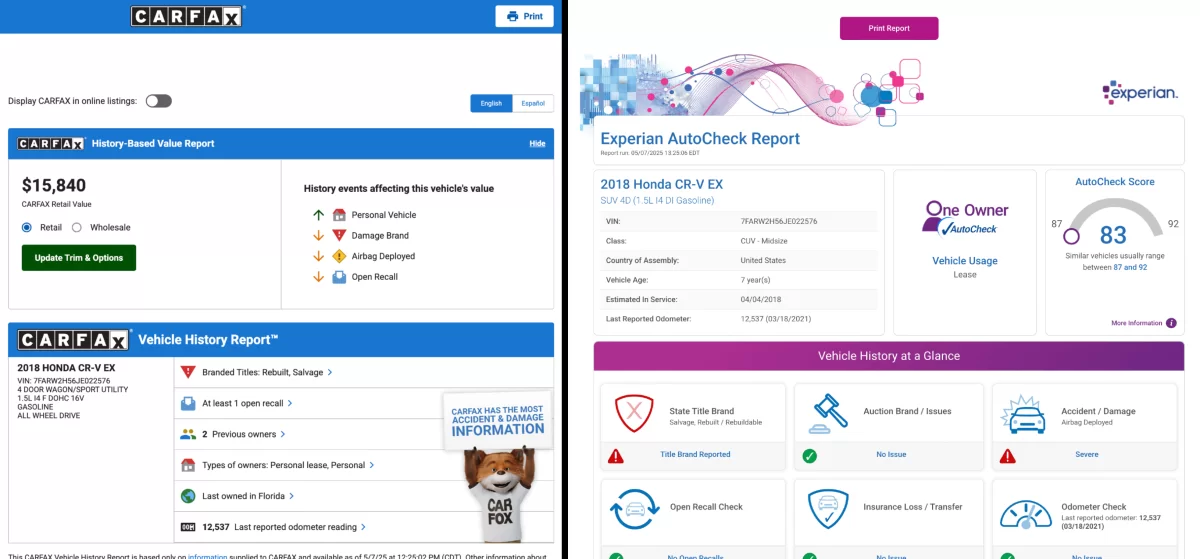
CarFax: The top of a CarFax report typically features a clean, high-level summary box. This area highlights key data points such as the number of previous owners, any reported accidents or damage, the number of service history records, and the last known odometer reading. This summary is often enhanced with prominent "CARFAX Badges," which are visual icons that quickly communicate positive attributes like "CARFAX 1-Owner" or "Well-Maintained Vehicle". Critically, this section is where the "History-Based Value" adjustment is often displayed, immediately framing the entire report in the context of its impact on the vehicle's price. The overall layout is widely regarded as user-friendly, with information organized into clearly labeled and digestible sections.
-
AutoCheck: The AutoCheck report summary is dominated by its signature feature: the AutoCheck Score. This is presented visually as a numerical gauge, similar to a speedometer, which shows the vehicle's score and its position within the expected range for similar vehicles. Directly below the score, a "Vehicle History at a Glance" section functions as a high-level checklist. It uses simple flags or icons to indicate whether issues have been found in critical categories like "State Title Brand," "Accident/Damage," "Odometer Check," and, unique to AutoCheck, "Auction Brand/Issues". This design prioritizes a rapid, almost binary risk assessment. Many users, particularly those in the industry, find this straightforward, color-coded approach easier to interpret for quick decision-making.
Presenting Key Problem Areas: Accidents and Title Brands
How each service details negative events like accidents and branded titles reveals their different approaches to data granularity.
-
CarFax: Information is generally organized owner-by-owner, with dedicated sections for "Title History" and "Additional History," where accidents and damage are detailed. When an accident is reported, CarFax often strives to provide more granular detail, which can include:
-
Damage Severity: A classification system that labels damage as "Minor," "Moderate," or "Severe," helping the user gauge the potential impact of the incident.
-
Point of Impact: In some cases, the report may include a simple vehicle diagram that graphically indicates the location of the reported damage (e.g., "front," "rear," "side").
-
Supporting Details: The report may also note if airbags were deployed and will sometimes include the police report case number, providing a valuable lead for further investigation.
-
-
AutoCheck: AutoCheck consolidates its problem checks into distinct, clearly delineated categories right in the summary, such as "Accident/Damage Check," "State Title Brand," and "Auction Issue". This structure makes it very easy to see if a flag has been raised in a specific high-risk area. While the report will note the event and may indicate severity , it is often perceived as providing less of a narrative or descriptive detail about the accident itself compared to CarFax. However, its unique strength lies in its ability to flag auction-specific problems, such as a vehicle being "Auction Announced as Structural Damage." This is a critical piece of information that might be buried or entirely absent from a CarFax report, representing a significant advantage in uncovering certain types of risk.
The Chronological Narrative: Detailed History
Both services provide a comprehensive, date-ordered timeline of all events reported during the vehicle's life. This section forms the evidentiary backbone of the report.
-
CarFax: The "Detailed History" section in a CarFax report is frequently praised for its readability and narrative flow. It effectively integrates service and maintenance records into the chronological timeline, creating a cohesive story of the vehicle's life from its first registration to the present day. Each entry typically lists the date, mileage, the source of the information (e.g., "California Motor Vehicle Dept." or "Jiffy Lube"), and comments detailing the event.
-
AutoCheck: The "Detailed Vehicle History" in an AutoCheck report also presents all events in chronological order. One subtle but potentially important difference is in how ownership is counted. Anecdotal evidence suggests CarFax is more likely to count a dealership taking temporary possession of a vehicle between private owners as a "new owner," which can inflate the owner count. AutoCheck, in contrast, may only count the final purchasers, resulting in a report that shows fewer owners for the same vehicle. Furthermore, AutoCheck's detailed history often gives more prominence to auction-related events, such as "REPORTED AT AUTO AUCTION" or "AUCTION ANNOUNCED AS FLEET/LEASE," which are central to its data ecosystem.
The layout and design choices of each report are not arbitrary; they are a direct extension of the core business strategies and target audiences previously identified. The user interface (UI) and overall user experience (UX) are meticulously tailored to serve their primary markets. CarFax's report is fundamentally designed as a retail narrative. Its clean, sectioned layout, the prominent placement of service records, and the "History-Based Value" are all geared towards a consumer who is attempting to build a story about the car's past to justify a significant purchase. It is structured to answer the retail buyer's core questions: "Is this a good car? Was it well taken care of? And is the asking price fair given its history?"
In contrast, AutoCheck's report is engineered as a wholesale risk assessment tool. The dominant AutoCheck Score, the at-a-glance checklist format, and the clear segregation of auction-related issues are all designed for a professional user who needs to make a rapid, data-driven "go/no-go" decision on potential inventory. It is structured to answer the wholesale buyer's core questions: "Are there any immediate, deal-breaking red flags? Does this vehicle's history disqualify it from purchase or require a significant price reduction?" This strategic divergence in design means that a typical consumer might find the AutoCheck report more clinical and its score potentially confusing, while a high-volume dealer might view the CarFax report as being cluttered with "irrelevant" service details that slow down their evaluation process. The "better" layout is therefore entirely subjective, its effectiveness dependent on the user's specific objective.
Economic and Market Dynamics
The competitive relationship between CarFax and AutoCheck is shaped not only by their data and product features but also by powerful economic and market forces. Their respective pricing strategies, brand positioning, and market perception create a dynamic that influences consumer behavior, dealer practices, and the overall accessibility of vehicle history information.
Pricing Strategy: A Clear Value Proposition Divide
The most straightforward economic differentiator between the two services is their pricing. They occupy distinct positions on the price spectrum, which reflects their different value propositions.
-
CarFax: The Premium Provider: CarFax is consistently positioned as the more expensive, premium service.
-
Single Report Pricing: A single CarFax report typically costs between $40 and $45.
-
Multi-Report Packages: While offering a lower per-report cost, CarFax's package deals remain significantly more expensive than AutoCheck's. Common pricing tiers include three reports for approximately $65 or five reports for around $100.
-
-
AutoCheck: The Budget-Conscious Alternative: AutoCheck is clearly marketed as the more economical choice, particularly for shoppers who need to research multiple vehicles.
-
Single Report Pricing: A single AutoCheck report is generally priced between $25 and $30.
-
Multi-Report Packages: AutoCheck's primary value proposition for consumers lies in its multi-report packages, which offer substantial savings. A common offer is five reports, valid for 21 days, for approximately $50. Some plans have even offered access to 25 or, for business clients, up to 300 reports, reinforcing its focus on high-volume users.
-
-
The Unofficial Market: It is worth noting that a gray market exists for these reports. Some users report successfully purchasing cheaper, single reports through third-party resellers on platforms like eBay or dedicated websites. However, the legitimacy, security, and reliability of these unofficial channels are not guaranteed.
Market Perception and Brand Power
Pricing is closely tied to brand perception, and in this arena, the two companies occupy very different spaces.
-
CarFax: The Household Name and "Default" Standard: CarFax has achieved a level of brand recognition that transcends the category; for many consumers, the brand name "CarFax" is synonymous with "vehicle history report". This is the result of years of direct-to-consumer marketing and has established the CarFax report as the perceived "gold standard". This brand power is a valuable asset for car dealerships, which frequently advertise "Free CarFax Reports" as a key marketing tool to build trust and confidence with potential buyers.
-
AutoCheck: The Trusted Industry Insider: While it may lack the top-of-mind consumer awareness of its rival, AutoCheck commands significant respect and usage within the automotive industry itself. It is the exclusive or preferred VHR provider for many major industry players, including large retailers like CarMax and influential online marketplaces like Kelley Blue Book and eBay Motors. Its affiliation with Experian, a global leader in credit and data analytics, provides substantial credibility, especially among automotive lenders and dealers who are accustomed to relying on Experian's data for financial decision-making.
The difference in pricing is not arbitrary but rather a deliberate strategic choice that actively shapes user behavior and market dynamics. CarFax's high price for a single report can create a psychological barrier, potentially discouraging a consumer from investigating a wide range of vehicles. A buyer might be more inclined to commit to a vehicle earlier in their search process, especially if a dealer provides a "free" report that appears clean. In contrast, AutoCheck's affordable multi-report packages are explicitly designed to facilitate and encourage comparison shopping, allowing a diligent buyer to vet several options before making a decision.
This pricing structure creates a subtle but powerful market inefficiency and a potential conflict of interest. A dealership that provides a "free" CarFax report—for which the dealer pays a significant subscription fee—is leveraging CarFax's immense brand power to build trust and close a sale. The high cost of purchasing an individual CarFax report may then deter that same buyer from spending an additional $25 to $30 to pull a competing AutoCheck report for a second opinion. This is particularly problematic given the numerous documented cases where the two reports contain critically different information. CarFax's combination of brand dominance and premium pricing can, therefore, inadvertently stifle the very due diligence that VHRs are meant to promote. The system can create a reliance on a single, dealer-provided source of information. In this dynamic, AutoCheck's lower price point and B2B focus position it as a tool for
cost-effective risk management at scale for industry professionals, while CarFax's pricing and brand power position it as a premium marketing and confidence-building tool for retail transactions.
The Buyer's Safety Net: Guarantees and Gaps
In an effort to build consumer trust and differentiate their products, both CarFax and AutoCheck offer a form of consumer protection, commonly known as a "Buyback Guarantee" or "Buyback Protection." However, a critical analysis of these programs reveals that their scope is far narrower than their names might suggest. Understanding the precise terms of these guarantees, alongside the well-documented reality of data gaps and discrepancies, is crucial for any consumer seeking to realistically assess their level of protection.
Buyback Guarantees Uncovered: A Narrowly Focused Protection
The "buyback" programs offered by both companies are not comprehensive warranties against any and all problems a used car might have. Their function is highly specific and limited.
-
Core Function and Coverage: The primary purpose of these guarantees is to protect a consumer if the VHR fails to report a severe, DMV-issued title brand that was officially on the vehicle's record before the date the report was generated. The covered title brands are a specific list of the most serious issues, typically including: Salvage, Junk, Rebuilt/Reconstructed, Fire Damage, Flood Damage, Hail Damage, Lemon Law/Manufacturer Buyback, and certain odometer-related brands like "Not Actual Mileage" or "Exceeds Mechanical Limits".
-
Crucial Exclusions: It is essential to understand what these guarantees do not cover. They provide no protection against unreported accidents, regardless of their severity, if the accident did not result in one of the specific state-issued title brands. They also do not cover mechanical failures, routine maintenance issues, or negative information that comes from non-DMV commercial sources, such as an "auction announcement" of structural damage. The protection is solely for errors in reporting specific, official DMV title data.
-
Key Differences in Terms: While the core premise is similar, there are some differences in the terms offered:
-
AutoCheck Buyback Protection: Pledges to reimburse the consumer for the vehicle purchase price up to 110% of the J.D. Power NADAguides published retail value at the time of purchase. It also provides an additional benefit of covering up to $500 in aftermarket accessories. To be eligible, the consumer must register the vehicle for the protection program on AutoCheck's website within 90 days of buying the car.
-
CARFAX Buyback Guarantee: The exact payout terms are based on the vehicle's purchase price, but the specific formula is less clearly defined in public-facing materials. A key condition is that the guarantee is not available for all vehicles. If a report already lists major damage or other significant issues, the vehicle may not be eligible for the buyback guarantee, a fact that must be verified on the specific report itself.
-
The Inevitable Blind Spots: When Reports Contradict Reality
The narrow focus of the buyback guarantees becomes particularly salient when contrasted with the widespread evidence of data gaps and discrepancies between the two services.
-
The Discrepancy Problem: The most consistent and alarming theme to emerge from real-world user experiences, particularly on automotive forums and social media, is the high frequency of significant discrepancies between CarFax and AutoCheck reports for the same VIN. It is not uncommon for one service to report a vehicle as "clean" while the other flags a major issue.
-
Case Example 1: A user investigating a Toyota RAV4 found that the AutoCheck report was perfectly clean, showing one owner and no accidents. The CarFax report for the same VIN, however, listed two owners and two separate accidents.
-
Case Example 2: A buyer purchased a vehicle from a major used car retailer based on a clean AutoCheck report. Curious, they later ran a CarFax report and discovered a history of "SEVERE DAMAGE," including the replacement of multiple body panels and the roof.
-
Case Example 3: A consumer's CarFax report showed only a vague "damage reported" entry. A subsequent AutoCheck report on the same vehicle revealed a much more serious event: an auction announcement for "Severe Structural Damage".
-
-
Data Lag and the Universe of the Unreported: These discrepancies are often compounded by significant delays in data reporting. A major event might not appear on a VHR for months or even years after it occurs, and it may surface on one service long before the other. A consumer could purchase a vehicle with a perfectly clean report, only to have a major accident from the previous ownership appear on its record two years later. This is in addition to the vast universe of information that is never reported at all, such as private-party repairs or accidents settled without official documentation. Furthermore, some data reporting practices can create confusion; for example, some body shop estimating software may automatically report "damage reported" to CarFax when an estimate is created, even if the owner chooses not to have the work done or repairs it elsewhere.
The "Buyback Guarantee" functions far more as a strategic marketing asset designed to build consumer confidence than as a comprehensive financial safety net. The scope of the guarantee is intentionally and precisely narrowed to cover only the most egregious and easily verifiable data errors—a failure to report an official, public DMV-issued title brand. This is likely the rarest type of data omission. By tightly defining the terms, the companies effectively shield themselves from liability for the most common, ambiguous, and financially damaging data gaps that consumers face: unreported accidents and undocumented poor maintenance.
This creates a "confidence gap." The consumer hears or reads the powerful term "Guarantee" and may feel broadly protected against buying a "bad car." The company, however, is only guaranteeing a very small and specific subset of the data it provides. The very existence of this guarantee may lull a buyer into a false sense of security, making them less likely to invest in the single most important risk-mitigation step: a professional pre-purchase inspection (PPI). The real-world value of the guarantee is minimal when it comes to a consumer's biggest risks, but its marketing value in overcoming purchase hesitation and building brand trust is immense. These programs are not insurance policies; they are confidence-building instruments with highly specific and limited liability.
Table 2: Buyback Guarantee Terms and Coverage
Final Synthesis and Strategic Recommendations
The analysis of CarFax and AutoCheck reveals two highly sophisticated, valuable, yet imperfect tools. Neither holds a definitive monopoly on accuracy, and each possesses unique strengths derived from distinct business strategies and market positioning. For the sophisticated consumer, declaring a single "winner" is less important than understanding how to leverage the strengths of both platforms within a broader, multi-layered strategy for risk mitigation.
The Verdict: A Use-Case-Driven Conclusion
The choice between CarFax and AutoCheck is not absolute; it is contingent on the specific needs of the user and the likely history of the vehicle being investigated.
-
CarFax is generally the more suitable tool for the average retail consumer whose primary goal is to understand a vehicle's day-to-day life and maintenance history. Its perceived strength in detailed service records and its user-friendly, narrative layout provide a powerful (though incomplete) story of how the car was treated by its previous owners. Furthermore, its dominant brand recognition means that a clean CarFax report is a valuable asset when it comes time to resell the vehicle, as it is the report a future buyer is most likely to request and trust.
-
AutoCheck is the superior tool in scenarios where a vehicle's history is unknown or suspected to involve auto auctions, or for budget-conscious buyers who are comparing numerous vehicles. Its exclusive access to data from the nation's largest auction houses can reveal critical issues like structural damage announcements that CarFax may miss entirely. This makes it an essential check for any vehicle that has passed through multiple dealer hands or has a spotty ownership record. Its more affordable pricing for multi-report packages makes it the clear economic choice for diligent shoppers who wish to vet a wide array of potential purchases before committing.
The Dual-Report Imperative: The Ultimate Risk Mitigation Strategy
Given the extensive and well-documented evidence of frequent, significant discrepancies between the two services, the single most critical recommendation of this report is unequivocal: for any vehicle under serious consideration for purchase, a consumer should obtain reports from both CarFax and AutoCheck.
The modest additional cost of a second report—typically between $25 and $45—is a negligible insurance premium when weighed against the immense financial and safety risks of unknowingly purchasing a vehicle with a history of severe accidents, undisclosed title brands, or hidden structural damage. This dual-report strategy is the most effective way for a consumer to create a more complete and robust historical picture. It allows the buyer to cross-reference the data, identify contradictions, and leverage the unique data strengths of both platforms, combining CarFax's potential depth in service history with AutoCheck's critical insights from the auction world.
A Practical Framework for the Buyer: From Report to Purchase
A vehicle history report is not an answer, but a guide to asking the right questions. The following framework outlines a strategic approach to using these reports effectively.
-
Step 1: Run Both Reports. Before investing significant time or emotional energy in a vehicle, obtain both a CarFax and an AutoCheck report using its VIN.
-
Step 2: Compare and Investigate Discrepancies. Place the reports side-by-side and conduct a thorough comparison. Pay extremely close attention to any contradictions, no matter how small, in accident history, damage reports, owner count, or title status. A clean report from one service paired with a negative report from the other is a major red flag that demands deep investigation or immediate disqualification.
-
Step 3: Use the Reports as a Guide, Not a Gospel. Acknowledge the inherent limitations of the data. A "clean" report does not certify perfection. Use the information to formulate a list of specific questions for the seller. Inquire about significant gaps in the service history. If an accident is listed, request all available repair documentation and invoices.
-
Step 4: The Non-Negotiable Final Step—The Pre-Purchase Inspection (PPI). No vehicle history report, or combination of reports, can ever substitute for a comprehensive physical inspection by a qualified, independent mechanic. If accidents or structural damage are reported or suspected, this should be supplemented with an evaluation by a body shop specialist. A PPI is the only way to uncover issues that are never reported, such as poor-quality collision repairs, emerging mechanical problems, hidden rust, or unreported frame damage. A seller's reluctance or refusal to permit an independent PPI should be considered an absolute deal-breaker.
The most effective mental model for a consumer to adopt is to view a VHR not as a tool for qualification, but as a tool for disqualification. The psychological momentum of the car-buying process often pushes a buyer to look for reasons to confirm their choice—to find evidence that they have found "the one." A more prudent, risk-averse mindset, however, uses the VHR as a coarse filter to find reasons to walk away.
A VHR's primary strength lies in its ability to provide clear, negative confirmation. A report that shows a salvage title, a history of severe structural damage, or a major odometer rollback is a definitive signal to disqualify that vehicle from consideration and move on, saving valuable time and avoiding a potentially catastrophic purchase. For the vehicles that pass this initial, harsh filter, the reports then transform into a roadmap of questions and areas of specific focus for the true verification step: the pre-purchase inspection.
This reframing of the VHR's purpose—from a "confidence builder" to a "risk identifier"—is critical. It prevents the consumer from falling into the "clean report" fallacy and aligns the use of the product with its actual capabilities and limitations. By using these reports to identify red lights, rather than to seek a green one, the consumer can navigate the used car market with a more informed, skeptical, and evidence-based strategy, providing the most effective protection possible.