You know that sinking feeling when you realize you've been played? That moment when your excitement about scoring an amazing deal transforms into the cold realization that you're about to become another cautionary tale? Yeah, I've been there. Multiple times. In fact, I've probably fallen for more Facebook Marketplace car scams than I'd care to admit - though my therapist says admitting it is the first step.
Look, I'm not proud of it, but I once drove three hours to see a "pristine" 2015 Accord that turned out to be two different Accords welded together. And no, I'm not making that up for dramatic effect. The seller called it "custom bodywork." I called it "what happens when you trust Facebook Marketplace too much."
So buckle up (see what I did there?), grab your coffee, and let me walk you through the automotive house of horrors that is Facebook Marketplace scams. Consider this your vaccination against stupidity - and trust me, I've got all the antibodies.
Scam #1: The "Too Good to Be True" Price Drop
This one's the gateway drug of Facebook Marketplace scams. You're scrolling through listings at midnight (don't judge me), and suddenly you see it: a 2020 Honda Civic Type R for $15,000. That's literally half the market price. Your brain starts doing mental gymnastics: "Maybe they need quick cash!" "Perhaps they don't know what they have!" "Could be a divorce sale!"
No. Stop. Put down the phone and step away from the listing.
I fell for this one with a suspiciously cheap BMW 335i. The seller had a whole sob story about medical bills and needing money fast. They even sent photos - beautiful, high-resolution photos that I later discovered were stolen from a dealer's website in Phoenix. The real kicker? They wanted a $500 deposit to "hold the car" because they had "so much interest."
The Red Flags:
- Price is 40-60% below market value
- Seller has elaborate story explaining the low price
- They're pushing for a quick sale
- Photos look too professional or have different backgrounds
- They want money before you see the car
Now, I'm not a mechanic, but... I've learned that when a deal seems too good to be true, it's usually because someone's trying to separate you from your money faster than a nitrous-equipped dragster.
Scam #2: The Magical Moving Vehicle
Oh, this one's special. You find a great car, message the seller, and suddenly the car has teleported to another state. "I just moved for military duty," they'll say. Or my personal favorite: "I'm going through a divorce and the car is at my aunt's house in Nebraska."
The first time I encountered this, I was actually sympathetic. Military family, tough situation, I get it. Then they explained how we could complete the transaction through this "totally secure" shipping company that would hold my money in "escrow." Spoiler alert: There was no shipping company, no military duty, and definitely no car.
The dead giveaway? They always want to handle everything remotely. No test drives, no inspections, just trust and money transfers. It's like buying a car with your eyes closed while standing on one foot - technically possible, but why would you?
Scam #3: The VIN Switcheroo
This one's crafty, and it almost got me good. You ask for the VIN (Vehicle Identification Number for those keeping track at home), and they give you one. You might even run a basic check and everything looks clean. But here's the trick - they're giving you the VIN from a similar car with a clean history.
I was looking at a 2017 Mazda3, and the seller promptly provided a VIN. Being the responsible buyer I'd become (after several expensive lessons), I headed to carvins.net to grab a vehicle history report for my usual $5. The report came back clean - too clean for a car with visible body damage in the photos.
That's when I noticed it: the VIN in the windshield photo didn't match what they'd texted me. When I confronted them, they suddenly had "another buyer" and stopped responding. That other buyer? Probably their imaginary friend who also fell for their BS.
How to Protect Yourself:
- Always verify the VIN from multiple places on the car (windshield, door jamb, engine block)
- Match the VIN against the title and registration
- Run that history report yourself - don't trust their printout
- If they won't let you verify the VIN in person, run away faster than a Honda Civic at a street race
Scam #4: The Curbstoner Special
A curbstoner is basically an unlicensed dealer pretending to be a private seller. They flip cars without a dealer license, often hiding problems and avoiding regulations. I've probably bought from three curbstoners before I knew what to look for - which explains why I kept ending up with cars that had more issues than a magazine stand.
The telltale signs? They're always selling their "grandmother's car" or their "cousin's vehicle." When you meet them, it's never at their house - always some random parking lot. And if you check their Facebook profile, you'll see they've been selling their grandmother's car every month for the past year. Either granny has a serious car collecting problem, or something's fishy.
My favorite curbstoner encounter was a guy selling a "family minivan." When I asked why the registration had a different name, he said it was his sister's. When I pointed out the name was clearly masculine, suddenly it became his brother-in-law's. By the end of our conversation, this van had more previous family owners than a royal crown.
Scam #5: The Deposit Trap
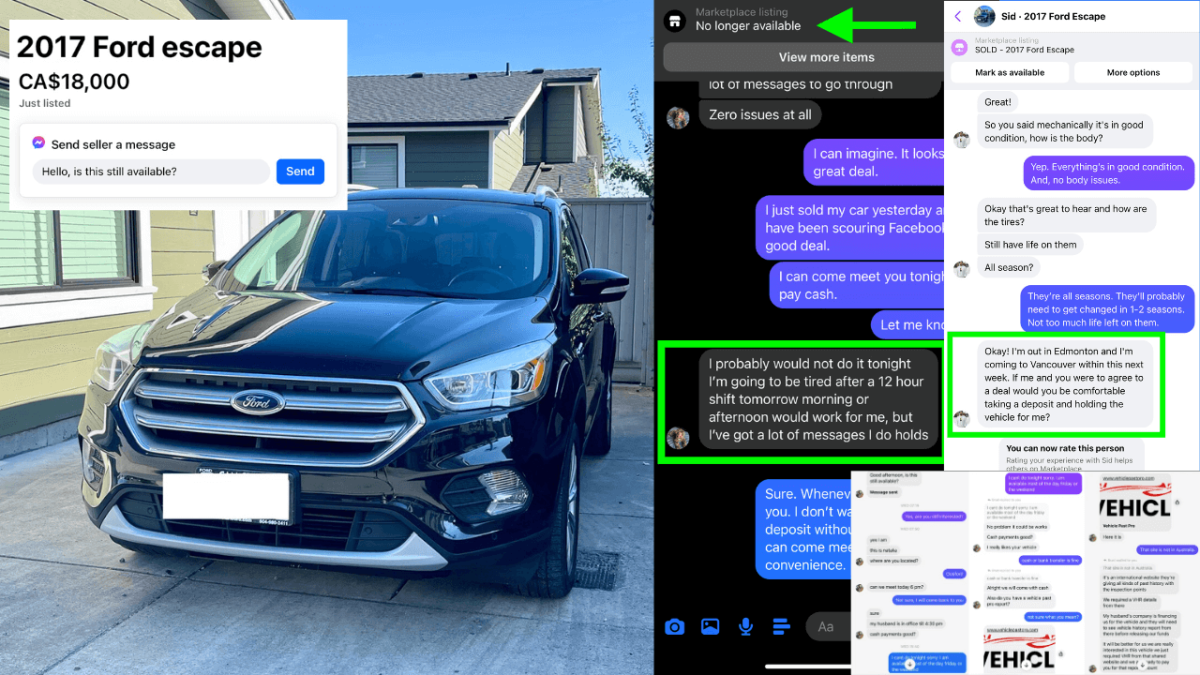
This one still makes my blood pressure spike like a turbocharged engine. You find a car, exchange messages, everything seems legit. Then they hit you with: "I have five other people coming to look at it today. Send me a $200 deposit to hold it."
Look, I understand the logic. You don't want to lose a good deal. But here's what I learned after losing $300 to a "seller" who vanished faster than my motivation to exercise: legitimate sellers don't need deposits from strangers on the internet.
The worst part? These scammers are smart. They'll have multiple photos, answer questions about the car (usually with vague responses), and even agree to meet - after you send the deposit, of course. Then suddenly their "mother is in the hospital" or they "had to leave town for work," and that meeting keeps getting pushed back until you realize you've been played.
Scam #6: The Title Washing Game
This one's sophisticated enough that it fooled me twice before I caught on. Title washing is when someone takes a car with a salvage or flood title and registers it in a state with looser regulations to get a clean title. It's like giving a car a fake ID, and it's surprisingly common on Facebook Marketplace.
I once bought a Camry that seemed perfect. Clean title, decent price, seller seemed knowledgeable. It wasn't until I ran a comprehensive vehicle history report through carvins.net (seriously, best $5 insurance policy ever) that I discovered this car had been swimming in Hurricane Harvey. The title had been washed through three different states before landing in Ohio with a clean designation.
The seller acted shocked when I confronted them. Oscar-worthy performance, really. "I had no idea!" they exclaimed, despite definitely knowing exactly what they were doing. That car ran okay for about two months before the electrical system started acting like a disco light show.
Scam #7: The Fake Cashier's Check Hustle
Now, this one usually targets sellers, but buyers can get caught too. You agree on a price, and the scammer shows up with a cashier's check for more than the asking price. "Oops," they say, "my bank made an error. Just give me the difference in cash, and we're good."
That check? It'll bounce harder than a lowered Civic going over a speed bump. By the time your bank figures out it's fake (usually 5-10 days later), the scammer is long gone with your car AND your cash.
I nearly fell for this when selling my old Accord. The buyer seemed so apologetic about the check error, even offered to let me "keep an extra $100 for the trouble." Something felt off though - maybe it was how he kept checking his phone and insisting we hurry. I told him we'd wait for the check to clear. He left faster than a Mustang leaving a car meet.
Scam #8: The Phantom Mechanic Inspection
This one's clever because it uses our own good advice against us. You know how I always say to get a pre-purchase inspection? Well, scammers know we say that too.
Here's how it works: They'll agree to an inspection but insist on using "their mechanic" who gave them a "great deal" on recent work. You show up, and surprise! The mechanic is their buddy who gives the car a clean bill of health while ignoring the fact that it's held together with bubble gum and hope.
I experienced this with a Civic Si that allegedly just had "$3,000 in engine work." Their mechanic showed me receipts, pointed out new parts, the whole show. What he didn't mention was that the timing chain was about two miles away from snapping and taking the engine with it. Found that out during my own inspection later - after I'd already wasted half a day and gas money.
Scam #9: The Emotional Manipulation Play
This one's rough because it preys on good people trying to help. The seller has a sob story that would make a country song writer jealous. Sick kids, dying parents, job loss, house foreclosure - they've got a tragedy buffet, and they're serving all courses.
Now look, life happens, and sometimes people really do need to sell cars quickly due to hardship. But scammers have weaponized empathy. They'll use these stories to pressure you into skipping inspections, overlooking problems, or sending money sight unseen.
I once almost bought a minivan from a "single mom who just needed to feed her kids." The story was heartbreaking. The photos of the van looked good. The price was fair. But when I insisted on seeing it in person and running the VIN through carvins.net for a history report, suddenly she got aggressive. Turns out the "single mom" was actually a 22-year-old dude named Kyle who'd been running this scam for months.
Scam #10: The Classic Bait and Switch
Saved the most frustrating for last. You see a listing for a beautiful 2018 Camry, low miles, great price. You message immediately, set up a meeting, drive across town (why is it always across town?), and when you arrive... surprise! That Camry "just sold," but hey, look at this 2009 Corolla with questionable history they happen to have!
This happened to me three times before I caught on. Yes, three. Don't judge - the first time, I actually thought it was bad timing. The second time, I started getting suspicious. By the third time, when yet another "perfect car" had just been sold but they had this other option that looked like it had been through a demolition derby, I finally connected the dots.
The worst part? Sometimes they don't even have the bait car. It never existed. Those photos? Stolen from some dealer in another state. They're just trying to get you there, hoping you'll be desperate enough to buy whatever rust bucket they're actually selling.
Your Defense Playbook
Alright, so now that I've probably scared you away from ever buying a car again, let me give you the defensive playbook I've developed through painful trial and error:
1. Trust your gut - If something feels off, it probably is. That little voice in your head? Listen to it. It's smarter than the voice saying "but it's such a good deal!"
2. Always verify in person - No legitimate seller will have a problem with you inspecting the car, checking the VIN, and taking it for a test drive. If they do, that's your cue to leave.
3. Run your own reports - Never trust a seller's vehicle history report. Spend the $5 at carvins.net and get your own. I've seen fake Carfax reports that looked convincing until you actually verified them.
4. Meet in safe, public places - Police stations often have designated areas for online transactions. Use them. If a seller won't meet you there, ask yourself why.
5. Never send money before seeing the car - I don't care if they promise to name their firstborn after you. No deposits, no wire transfers, no payment apps. Cash or cashier's check at the time of sale only.
6. Research the seller - Check their Facebook profile. How long have they had it? Do they sell cars often? A little stalking (the legal kind) can save you a lot of trouble.
7. Bring a friend - Two sets of eyes are better than one, and it's harder to pressure two people than one. Plus, they can talk you out of bad decisions, like that time I almost bought a "rare" V6 Mustang. (Spoiler: V6 Mustangs aren't rare.)
The Silver Lining
Look, I know this all sounds doom and gloom, like Facebook Marketplace is just a den of thieves waiting to steal your money and sell you a lemon. But here's the thing - for every scammer I've encountered, I've met ten honest people just trying to sell their cars.
The key is being smart about it. Do your homework, verify everything, and never let excitement override common sense. Some of my best car purchases have come from Facebook Marketplace - including my current daily driver, that 2016 Civic Si I mention way too often. (What can I say? When you find a good one, you brag about it.)
Just last month, I helped my neighbor score an amazing deal on a Subaru Outback from a retiring couple who had every service record since new. We ran the history report on carvins.net, got a PPI, and everything checked out perfectly. She saved thousands compared to dealer prices, and the sellers were lovely people who still send her photos from their RV travels.
Final Thoughts from Someone Who's Been There
If you take anything from my encyclopedia of failures, let it be this: scammers rely on two things - your emotions and your ignorance. They want you excited, rushed, and uninformed. Your job is to be calm, thorough, and educated.
Will you still encounter scammers? Probably. Will some of them be convincing? Definitely. But armed with knowledge and a healthy dose of skepticism, you can navigate Facebook Marketplace like a pro. Or at least like someone who's only been scammed once or twice instead of... well, let's not put a number on my record.
Stay safe out there, trust your instincts, and remember - if someone's grandmother is selling her third Corvette this month, maybe ask some questions. And whatever you do, always get that vehicle history report. Five dollars at carvins.net might just save you from becoming the protagonist in your own cautionary tale.
Now if you'll excuse me, I need to go check Facebook Marketplace. I just saw a listing for a mint condition... oh no, here we go again.
- JT
P.S. - If you're reading this and you're the guy who sold me that "two Accords welded together" monstrosity, I'm still not over it. But I did get a great story out of it, so... thanks?