Welcome to the Digital Wild West of Used Cars
Hey folks, James here. The other day, I was doing what a lot of us do—scrolling through Facebook Marketplace, not really looking for anything, just… looking. And there it was. Tucked between a slightly-too-cheap speedboat and a collection of porcelain cats, was a gem: a 15-year-old station wagon, dark green, with mileage so low it had to be a typo. One owner, a garage-kept cream puff. I called my buddy whose daughter just got her license, and a few days later, she was driving a safe, reliable car we got for a song. That’s the magic of the Marketplace.
But for every unicorn like that, there’s a nightmare waiting. I remember another time, a fella was selling a big, beautiful pickup truck. Looked tough as nails in the pictures. We’re messaging back and forth, and I ask for the VIN, just standard procedure. He gets a little cagey, but finally sends it over. I run the report, and BAM. The thing had a "Rebuilt" title. He’d "forgotten" to mention it was in a wreck so bad the insurance company had declared it dead and buried.
That’s the deal with Facebook Marketplace. It’s the Wild West of used cars. It’s a place where you can find incredible deals directly from regular folks who just need to sell their car, with no slick dealership overhead to pump up the price. But it’s also a dusty, lawless town full of scammers, flippers selling patched-up auction junk, and people trying to pass off their problems as your next ride. The barrier to entry is so low that anyone can list anything, which is both its greatest strength and its most serious weakness.
So, your job as a buyer isn’t just to find a car you like. Your real job is to be a detective, a mechanic, and a bit of a psychologist. It’s to systematically weed out the bad actors and the bad cars so you can get to the good ones. This guide is your playbook. It’s everything I’ve learned from years with my head under a hood, translated for the digital age. We’re going to walk through this whole process together, from the first click to the final handshake, so you can navigate the risks and drive away with the reward. Grab a coffee, and let's get our hands dirty.
Part I: Gearing Up for the Hunt – Prep Work is Everything
Before you even open the Facebook app, you’ve got homework to do. Rushing into this unprepared is like trying to build an engine without a socket set—you’re just going to make a mess and hurt yourself. Good preparation is what separates a smart buyer from a sucker.
Setting a REAL Budget (More Than Just the Sticker Price)
That price you see on the listing? That’s just the cover charge. The real cost of getting that car into your driveway and keeping it there is always higher. Smart buyers budget for the Total Cost of Acquisition, which is a fancy way of saying "all the money you're actually going to spend."
- The Purchase Price: This is the number you and the seller agree on after you’ve negotiated. We’ll get to the art of the haggle later.
- Taxes and Fees: Don’t ever forget about the government. Every state has its own rules for sales tax, title transfer fees, and registration fees. This can easily add hundreds, or even thousands, of dollars to your final bill. You can usually find a fee calculator on your state’s DMV website. Look it up beforehand so you’re not caught by surprise.
- Immediate Insurance: You cannot legally drive that car one inch without insurance. Before you even go to see a car, call your insurance agent. Find out what it will cost to add the specific make and model to your policy and what their process is for insuring a new vehicle purchase. Some states require you to have insurance in place *before* you can even register the car. The moment that title is signed, you are responsible for that vehicle, so you need to be ready to make that call to your insurance company on the spot.
- The "Oh, Bother" Fund: This is my personal term for a contingency fund, and it’s the most important part of your budget. When you buy a car from a private seller, it is sold "as-is, where-is." That means there is NO warranty. Once you hand over the money, all of its problems are now your problems.[1] I tell everyone to set aside at least 10-15% of the car’s purchase price for immediate repairs. Maybe it needs new tires next month. Maybe the alternator gives up the ghost a week later. Even with a great inspection, used cars are used cars. This fund is your only safety net.
Mastering the Marketplace Search
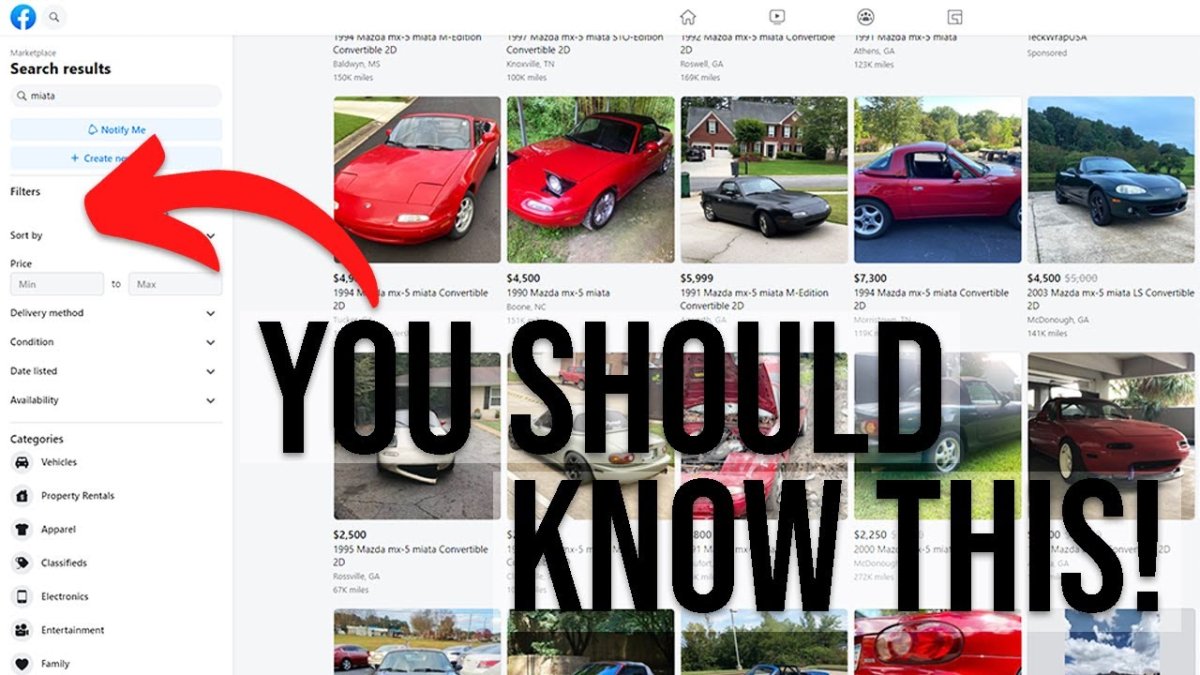
Alright, with a real budget in mind, now you can go hunting. Facebook’s search tool is pretty powerful if you know how to use it.
Start by plugging in your basic criteria using the filters: make, model, year, price range, and mileage. Be realistic. You’re not getting a 2-year-old truck with 20,000 miles for $5,000. Set your location radius to something you’re actually willing to drive.
Your goal here isn’t to find "the one." It’s to create a shortlist of three or four promising candidates. This is SO important. When you only focus on one car, you get emotionally attached. You start making excuses for its flaws. But when you have a few options, you stay objective. You can compare them against each other, and it gives you the power to walk away from a bad deal because you know you have other cars to see. It’s the single best way to keep a level head.
While you’re at it, it doesn’t hurt to pop over to other sites like Craigslist or AutoTrader to see what similar cars are listed for. This gives you a better feel for the true market value and helps you spot a Facebook listing that’s priced way too high or suspiciously low.
Part II: Separating the Gold from the Garbage – The Vetting Phase
This is where the real detective work begins. Before you waste your time and gas driving all over town, you’re going to use the power of the internet to disqualify the junk, the scams, and the shady sellers. This phase is all about risk mitigation.
Reading Between the Lines of a Listing
A Facebook Marketplace listing is a story, and you need to learn how to read it. The seller is trying to present the car in its best light, but the pictures and words often reveal more than they intend.
First, the photos. Be a skeptic. Are the pictures taken at night, in the rain, or are they blurry? That’s a classic trick to hide bad paint, dents, and rust. A confident seller will provide clear, well-lit photos from every angle—front, back, both sides, the interior, the dashboard, the engine bay, and even the trunk. If they’re only showing you the car’s "good side," you have to wonder what’s wrong with the other side. Look for a picture of the dashboard with the car turned on. If there isn’t one, it could be because the check engine light or another warning light is glowing.
Next, dissect the description. Vague is bad. "Runs good, AC cold" tells you nothing. A good listing will include the exact mileage, recent repairs (like "new battery in March," "tires replaced last year"), and any known issues. Be wary of long, dramatic sob stories about why they have to sell their beloved car—it’s often just a tactic to make you feel sorry for them and lower your guard.
And then there’s the biggest red flag of all: if a deal seems too good to be true, it is. Every single time. A 2018 Honda CR-V with 40,000 miles for $8,000 isn’t your lucky day; it’s a scammer using a fake listing to steal your deposit. The internet is not a magical place where market value ceases to exist.
The First Contact – Your First Litmus Test
Once you’ve found a promising listing, it’s time to reach out. Your first message is a test. Don’t, under any circumstances, send the generic, pre-filled "Is this still available?" message. Sellers get dozens of these, and it makes you look like a lazy, non-serious buyer.
Instead, ask a specific, intelligent question that isn’t answered in the ad. This shows you’ve actually read the listing and you know a thing or two. Good examples are:
- "Hi, I'm interested in your Civic. Could you tell me if the timing belt has been replaced?"
- "The truck looks great. Do you have the service records available for it?"
- "I see the mileage in the description. Do you happen to have the VIN so I can look up the history report?"
That last one is the most important question you will ask. The Vehicle Identification Number (VIN) is the car’s social security number. It’s a 17-digit code usually visible on a small plate on the driver’s side of the dashboard, right at the bottom of the windshield, or on a sticker in the driver's door jamb. A legitimate seller will have absolutely no problem giving it to you.
If a seller refuses to provide the VIN, makes excuses, or gets defensive, end the conversation immediately. There is no legitimate reason to hide the VIN. They are hiding something serious about the car’s history—a salvage title, odometer fraud, a past wreck—and you should run, not walk, away from the deal.
Playing Detective – Vetting the Seller
Unlike the anonymity of Craigslist, Facebook gives you a powerful tool: the seller’s profile. Before you get too invested, do a little snooping.
Click on their name and look at their profile. Does it look like a real person? Or was the account created last week, with no friends and a stock photo for a profile picture? These are the hallmarks of a scammer who creates disposable accounts to rip people off. Check their Marketplace rating and see what other people have said about buying from them.
Your goal here is to figure out who you’re dealing with, because not all sellers are created equal. In my experience, they fall into three main categories:
- The Genuine Private Seller: This is who you want to find. It’s someone selling their own personal car because they’re upgrading, their family is growing, or they just don’t need it anymore. They usually know the car’s history, have some service records, and are generally honest about its condition.
- The Flipper (or "Curbstoner"): This is a person who buys cars, often cheap from auctions, cleans them up, and sells them from their driveway for a profit. They often try to pose as a private seller to get around the laws and regulations that licensed dealers have to follow. You can often spot them by checking their other Marketplace listings—if they’re selling three different 10-year-old sedans, they’re not a private seller. The biggest risk with these guys is a practice called "title skipping" or "title jumping." This is where they buy the car, but never legally put the title in their name. They just hand you the title that was signed by the *previous* owner. This is illegal in most states and can turn into a legal and bureaucratic nightmare for you when you try to register the car. Always ask them point-blank: "Is the title in your name and will you be the one signing it?" If they hesitate or say they’re "selling it for a friend," be very, very careful.
- The Scammer: This person doesn’t have a car. They have stolen pictures and a good story. Their goal is to get you to send them money for a car that doesn’t exist. They’ll ask for a deposit to "hold it" for you, or they’ll ask you to pay for shipping. They will almost always try to get you to communicate outside of Facebook Messenger, asking for your email or phone number so they can send you fake invoices or phishing links.
The VIN is Your Crystal Ball – Decoding the Vehicle History Report (VHR)
Once you have the VIN from a seller who seems legitimate, you absolutely MUST run a Vehicle History Report (VHR). Don't cheap out on this. A $40 report from a trusted source like CarFax or AutoCheck can save you from a $4,000 mistake. Be very wary of sellers who send you a link to a "free report" from a weird-looking website; these are often phishing scams designed to steal your information. Buy the report yourself so you know it’s legitimate.
Getting the report is easy. Reading it and understanding what it *really* means is the important part. It’s the car’s permanent record, its rap sheet. Here’s how to decode the most important sections.
| VHR Red Flag Decoder | ||
|---|---|---|
| VHR Term | Simple Definition | James's Garage Talk (What It REALLY Means) |
| Salvage Title | The insurance company declared the car a total loss due to a severe wreck, flood, fire, or other major damage. | This car is a zombie. It was officially declared dead and sent to the automotive graveyard. It is DANGEROUS and, in most states, not even legal to drive on the road. Unless you are a professional mechanic building a dedicated race car, you should avoid this at all costs. |
| Rebuilt Title | A salvage car that has been patched up and passed a very basic state safety inspection to be made road-legal again. | The zombie car got a cheap suit and some makeup. It might look okay, but its bones—the frame—could be permanently twisted. It will likely have electrical gremlins for the rest of its life, its value is permanently destroyed, and getting full coverage insurance will be a nightmare. |
| Flood/Fire Damage | The title has been branded because the car was submerged in water or involved in a significant fire. | Water is absolute cancer for a car's complex electronics and wiring harnesses. It causes corrosion that can lead to bizarre, untraceable problems years down the road. Fire damage compromises the strength of the metal. Run away. Fast. |
| Lemon Law Buyback | The car had so many repeated, unfixable defects that the manufacturer was legally forced to buy it back from the original owner. | This car was literally born bad. The people who DESIGNED AND BUILT it couldn't fix its problems. You are not going to have better luck. This is a massive red flag. |
| Structural Damage Reported | The report indicates the car's frame or unibody—its core skeleton—was damaged in an accident. | This is a big deal. The frame is the foundation of the entire car. If it's been compromised, the car may never drive straight, it will chew through tires, and it will be significantly less safe in a future crash. |
| Airbag Deployment | The report shows the airbags went off in a collision. | This wasn't a little parking lot bump; this was a major impact. You have to be absolutely certain the airbags were replaced by a qualified professional with new, proper parts, not just removed or bypassed. Your safety depends on it. |
| Multiple Owners / Short-Term | The car has been bought and sold many times, especially over a short period. | This is a classic case of "hot potato." Everyone is trying to get rid of it. You have to ask yourself why. Is there a persistent, annoying problem that nobody wants to deal with? |
| Rental/Fleet/Taxi Use | The car was previously owned by a rental agency, a company, or used as a taxi. | These cars live the hardest lives imaginable. Think about how people drive rental cars—they're not gentle. They've had hundreds of different drivers, lots of stop-and-go city miles, and often delayed maintenance. This doesn't make them an automatic "no," but it means they need EXTRA scrutiny.[1] |
| Odometer Discrepancy | The mileage reported at one event (like an inspection) is lower than a previous reading, or there are huge, illogical gaps in mileage reporting. | This is one of the biggest deal-breakers. It's a huge sign of odometer rollback, which is a federal crime. It means the car has far more wear and tear on its engine, transmission, and suspension than the dashboard would lead you to believe. |
| Gaps in Service History | The report shows long stretches of time with no reported maintenance, like oil changes or inspections. | This could mean two things. Best case, the owner was a diligent do-it-yourselfer who changed their own oil. Worst case, the car was severely neglected, and that lack of basic care can lead to catastrophic engine damage down the road. It's a yellow flag that requires more investigation. |
Part III: Boots on the Ground – The Inspection and Test Drive
If a car has passed all your digital checks, it's finally time to see it in the flesh. This is where you put your hands on the metal and find out if the car's real-life story matches the one you've been told.
The Meetup – Safety First
Your personal safety is more important than any car deal. Never, ever agree to meet a seller at their home, and don’t have them come to yours.
Arrange to meet in a public, well-lit, and busy location. The parking lot of your local police department is a fantastic option; it tends to scare off anyone with bad intentions.[5] A busy shopping center during the day also works well. The absolute best place to meet, however, is at the parking lot of the independent mechanic you’ve chosen for the Pre-Purchase Inspection.
And bring a friend. Always. It’s not just for safety; a second set of eyes and ears can catch things you might miss while you’re focused on talking to the seller or checking under the hood.
The Mechanic's Eye & The All-Important Test Drive
When you first see the car, don't let the seller's chatter distract you. You're there to do a job. The best way to do that is to follow a systematic checklist. It keeps you focused and makes sure you don't forget anything. This is my personal checklist, broken down into a logical flow. Print it out, put it on your phone, whatever you need to do.
| The Ultimate Inspection & Test Drive Checklist | ||
|---|---|---|
| Category | Checkpoint | What to Look/Listen/Feel For |
| Exterior | Walkaround | Stand back and look at the car. Does it sit level? Do the colors of the doors, fenders, and bumpers all match perfectly? Mismatched paint is a dead giveaway of a past repair. |
| Body Panels | Run your finger along the gaps between the hood and fenders, and around the doors and trunk. Are the gaps tight and even all the way around? Wide or uneven gaps can mean a shoddy accident repair. | |
| Tires | Are all four tires the same brand and model? If not, it can be a sign of cutting corners. Check the tread depth (the "penny test" works fine). Look for uneven wear on the inside or outside edges of the tires—this points to alignment or suspension problems. | |
| Glass | Check the windshield for any chips or cracks. A small chip can quickly turn into a large, expensive-to-replace crack.[29] | |
| Interior | The Sniff Test | Stick your head inside and take a deep breath. Does it smell musty or like mildew? That's a huge red flag for a water leak or past flood damage. A heavy air freshener smell might be trying to cover something up. |
| Seats & Belts | Sit in every seat. Do they adjust properly? Pull out every seatbelt to make sure it extends and retracts smoothly. | |
| Electronics | This is tedious but necessary. Turn on every single thing. Radio, AC, heat, power windows, power locks, power mirrors, sunroof, seat heaters, turn signals, headlights (high and low beams), brake lights, interior lights. Every button. Repairs can be surprisingly expensive. | |
| Under the Hood | Cold Engine | Make sure the engine is cold when you arrive. A seller might warm up the car beforehand to hide starting problems or noises that only happen when cold. |
| Fluids | Check the engine oil dipstick. Is the oil golden brown or black? If it looks milky or frothy like a latte, that's a sign that coolant is mixing with the oil—a potential head gasket failure, which is a HUGE repair. Check the transmission fluid (on most cars, with the engine running). It should be pinkish-red and not smell burnt. Brown, burnt-smelling fluid is a bad sign. | |
| Leaks & Hoses | With a flashlight, look for any signs of active drips on the ground underneath the engine. Look for wet spots or stains on the engine itself. Squeeze the big rubber hoses—they should be firm, not brittle, mushy, or cracked. | |
| Test Drive (Cold Start) | The Start-Up | Turn the key. Does the engine fire up instantly and settle into a smooth idle? Or does it crank for a long time, sputter, or shake? Listen for any loud knocking, ticking, or grinding sounds. |
| The Exhaust | Walk to the back of the car right after it starts. Is there any visible smoke? A little white vapor on a cold day is normal. But heavy blue smoke means the engine is burning oil. Thick white smoke that smells sweet means it's burning coolant (head gasket again). Black smoke means it's burning too much fuel. | |
| Test Drive (On the Road) | City Driving | Start in a quiet neighborhood or parking lot. Accelerate gently. Does the transmission shift smoothly, or does it jerk, hesitate, or slip?. |
| Braking | Find a safe spot and apply the brakes firmly (but not slamming them). Does the car stop straight, or does it pull to one side? Do you hear any loud grinding or squealing? Does the brake pedal feel firm and high, or soft and spongy?. | |
| Steering & Suspension | Drive over some bumps. Does the car absorb them well, or does it feel overly bouncy or make loud clunking noises? Worn shocks and suspension parts are a common issue. In an empty parking lot, turn the steering wheel all the way to one side and drive in a slow, tight circle. Listen for any clicking or popping sounds from the front wheels—a classic sign of a bad CV joint. | |
| Highway Speeds | If possible, get the car up to highway speed. Does it feel stable, or does it wander? Do you feel any vibrations in the steering wheel or through the seat? Step on the gas to pass—does it accelerate confidently, or does it feel sluggish?. |
The Ultimate Truth-Teller – The Pre-Purchase Inspection (PPI)
You can do the best visual inspection in the world, but you can't see everything. You don't have a lift to check the undercarriage for rust or hidden frame damage, and you don't have the diagnostic tools to check the car's computer systems. That's why the final, most crucial step of your evaluation is a Pre-Purchase Inspection (PPI) by a qualified, independent mechanic.
This is not optional. This is not something you skip to save a hundred bucks. The PPI is your ultimate leverage and your final escape hatch.
Think about it this way: when you start, the seller holds all the cards. They know the car's real history and its hidden problems. The VHR and your test drive help to even the playing field, but the PPI is what truly balances the scales of power. When you ask for a PPI, one of two things will happen:
- The Seller Agrees: A seller who is confident in their car will have no problem with you getting it inspected. You find a reputable independent shop (NEVER use a mechanic recommended by the seller), you offer to pay the fee (usually $100 to $250), and you arrange for the seller to meet you there. The mechanic will put the car on a lift and give you an unbiased, expert report on its true condition. This report is now a factual, third-party document that you can use as powerful leverage in your negotiation.
- The Seller Refuses: This is the biggest red flag in the entire process. If a seller says no to a PPI, they are telling you, without words, that they are hiding something serious. Their excuse does not matter. "I don't have time." "The car is perfect, it doesn't need one." "My cousin is a mechanic and he said it's fine." It's all nonsense. A refusal is a confession. You must thank them for their time and walk away immediately. No exceptions.
The PPI is the best money you will ever spend when buying a used car. It can either give you the peace of mind to buy with confidence, or it can save you from a multi-thousand-dollar disaster.
Part IV: The Art of the Deal – Negotiation and Secure Payment
Alright, the car has passed the VHR, your test drive, and the PPI. Now it's time to talk turkey. This part makes a lot of people nervous, but it doesn't have to be a confrontation. If you've done your homework, it's just a calm business conversation based on facts.
The Negotiation Playbook
Your goal isn't to steal the car; it's to arrive at a price that is fair for the car's *actual* condition, not just the condition described in the ad.
- Know Your Numbers: Before you even make an offer, know the car's fair market value. Use resources like Kelley Blue Book or Edmunds to find the "Private Party Value" for that specific year, make, model, and mileage. This is your anchor point.
- Use Your Evidence: This is where your hard work pays off. Lay out the facts calmly and respectfully. Don't be accusatory. Instead of saying, "You didn't tell me the brakes were bad," say, "The PPI report from the mechanic noted that the rear brake pads have about 15% life left, and they gave me an estimate of $350 to replace them." Point out cosmetic issues, worn tires, or anything else you found. You're not insulting their car; you're simply explaining the real-world costs you will have to bear immediately after buying it.
- Make a Reasonable First Offer: Your first offer should be less than you're ultimately willing to pay, but not so ridiculously low that you offend the seller and they shut down. A good starting point is often 10-15% below what you think is a fair final price. State your offer clearly and then explain *why* you arrived at that number, referencing the market value and the repair costs you've identified. Then, be quiet. Let them be the next one to speak.
- Be Willing to Walk Away: This is your superpower in any negotiation. If you and the seller are miles apart on price and they won't budge, it's okay to say, "I understand where you're coming from, but that's more than I'm able to spend based on the car's condition. Thank you for your time." Sometimes, they'll let you walk. And sometimes, as you're getting in your car, they'll have a change of heart. You have to be genuinely willing to leave the deal on the table.
Paying Up Without Getting Played
This is the moment of maximum risk. You're about to hand over a large sum of money to a stranger. Scams involving payment are incredibly common, so you need to be smart and firm about how the transaction happens.[3]
| Secure Payment Method Comparison | ||
|---|---|---|
| Payment Method | Security Level | James's Garage Talk (Pros & Cons) |
| Gift Cards / Wire Transfer | DANGER - SCAM | NEVER. EVER. DO. THIS. This is the preferred method of every scammer on the planet because the money is untraceable and gone forever. Any mention of paying with gift cards (eBay, Amazon, etc.) or a wire transfer is a 100% guaranteed scam. End the conversation and report them. |
| Personal Check | Very Low | A personal check can bounce, and most sellers know this. They are very unlikely to accept one, and you shouldn't rely on this method. |
| Cash | Low to Medium | Many private sellers will ask for cash. While sellers like it, it's risky for you. Carrying thousands of dollars in cash is a personal safety hazard, and there's no paper trail if something goes wrong. If you absolutely must use cash, the only safe way to do it is to meet the seller inside a bank branch. The teller can verify the bills are not counterfeit, and you have a secure, witnessed location for the transaction. |
| P2P Apps (Venmo, Zelle, Cash App) | Medium | These apps are designed for splitting dinner with friends, not for buying cars. They often have daily transfer limits, and more importantly, they offer little to no buyer protection for this type of large, "goods and services" transaction. A scammer could take the money and you'd have almost no recourse. Avoid for the full amount. |
| Cashier's Check | High | This is one of the best and safest options. A cashier's check is drawn against the bank's own funds, not a personal account, so it can't bounce. For maximum security, have the seller meet you at *your* bank. They can watch the teller print the check, so they know it's legitimate. You can then sign the paperwork right there at a desk in the bank lobby. |
| Bank/Wire Transfer | High | A direct bank-to-bank transfer is also very secure. Like with a cashier's check, the safest way to do this is for both buyer and seller to go to the bank together to initiate and confirm the transfer in person. This creates a clear digital record of the transaction. |
Part V: The Final Lap – Paperwork, Title, and Driving Home Legal
You’ve agreed on a price and have a secure payment method ready. Don't let your excitement cause you to stumble on the final, most important step: the paperwork. Getting this wrong can lead to a world of bureaucratic pain.
The Title Tango – The Most Important Piece of Paper
Let me say this as clearly as I can: The vehicle's title is everything. It is the legal proof of ownership. If there are any problems with the title, you are not buying a car; you are buying a very large, very expensive lawn ornament.
Follow these steps precisely, with no exceptions:
- The Seller MUST Have the Title: If the seller says the title is lost, or it's "in the mail," or their dog ate it, WALK AWAY. They need to go to the DMV and get a replacement title *before* they can legally sell the car to you.
- Verify the Owner: The name printed on the front of the title under "Registered Owner" MUST be the name of the person standing in front of you. Ask to see their driver's license or photo ID. If the names do not match, WALK AWAY. You are likely dealing with an illegal "title skipper".
- Check for Liens: Look for a section on the title for "Lienholder." If a bank or credit union is listed there, it means there is still a loan on the car. The seller cannot legally sell it to you without a separate, official "Lien Release" letter from that financial institution. Without that letter, the bank still has a legal claim to the car, even after you've paid for it.
- Sign on the Dotted Line: Once you've verified everything, it's time to sign. The seller signs and prints their name in the "Seller" section. You sign and print your name and address in the "Buyer" section. The seller must also write in the current odometer mileage and the date of sale. Use black or blue ink, and don't make any mistakes or cross-outs, as this can void the title.
Never, ever hand over payment until you have a properly signed and verified title in your hand.[27]
The Bill of Sale – Your Receipt
While the title is the official legal document, a Bill of Sale is your personal receipt and a written record of the deal. Some states require it. It’s a simple document that you can find templates for online. It should include:
- Buyer and seller names, addresses, and signatures
- Vehicle year, make, model, and VIN
- The final purchase price
- The date of the sale
- A statement that the vehicle is being sold "as-is"
Both you and the seller should sign two copies, and each of you keeps one.
Navigating the DMV Maze
You’ve got the keys, the signed title, and the bill of sale. You’re almost done. The final step is making it all official with the government. This process varies a bit by state, but the core steps are universal.
- License Plates: The seller MUST remove their license plates from the car before you drive away. They belong to the seller, not the car. It is illegal for you to drive on their plates.
- Get it Home: To legally drive the car home, you may need to go to the DMV first to get a temporary tag or permit. Check your state's rules beforehand.
- Title Transfer and Registration: Within a set number of days (often 10-30, depending on the state), you must go to your local DMV or licensing agency. You will need to bring the signed title, the bill of sale, proof of insurance, and your driver's license. You will officially transfer the title into your name, register the vehicle, and pay the required sales tax and fees.
- Inspections: Some states require the vehicle to pass a safety inspection and/or an emissions (smog) test before you can complete the registration.
The best and safest way to handle the final payment and paperwork is to do it all with the seller at a DMV office or a licensed title/tag agency. That way, you can ensure all the paperwork is correct before any money changes hands.
Special Section: A Field Guide to Facebook Marketplace Car Scams
Scammers are creative, but they tend to use the same playbook over and over. If you learn to recognize their tactics, you can shut them down before they ever get started. Here’s a quick-reference guide to the most common scams.
| A Scammer's Playbook at a Glance | |||
|---|---|---|---|
| Scam Name | The Play | Red Flags | Your Counter-Move |
| Deposit / Advance Payment Scam | The seller creates a sense of urgency and pressures you to send a deposit to "hold" the amazing deal. Once they have your money, they vanish. | Price is too good to be true, seller has excuses for not meeting in person, they pressure you to act fast. | NEVER pay for a car you haven't seen and inspected in person. No deposits, no "holding fees," no exceptions. |
| Fake VHR / Phishing Scam | The seller sends you a link to a "vehicle history report" website that looks real but is designed to steal your credit card number or Facebook login info. | Seller insists you use *their* specific report site, the URL looks slightly off (e.g., "Carfax-reports-online.com"). | NEVER click on links sent by the seller. Politely decline and purchase your own VHR from the official CarFax or AutoCheck website. |
| Overpayment Scam | The scammer (posing as a buyer) "accidentally" sends you a fake cashier's check or digital payment for more than the asking price. They then ask you to refund them the difference. Their payment bounces, but your refund to them is real money. | Buyer offers to pay more than the asking price, uses a convoluted story, creates urgency for you to send money back. | Refuse the payment. Insist on the exact agreed-upon amount via a secure method. This is 100% a scam, every time. |
| "Just Needs..." Scam | The seller lists a car with what sounds like a simple, cheap fix ("just needs a new battery," "just needs a fuse for the AC"). In reality, this is a symptom of a much larger, more expensive problem.[3] | The price is suspiciously low for the vehicle, the seller is very casual and downplays a mechanical issue. | Trust nothing the seller says about mechanical issues. This is precisely what a Pre-Purchase Inspection (PPI) is for. Let a neutral, professional mechanic tell you what it "just needs." |
| Gift Card Scam | The seller invents a story about why they need you to pay for the car using untraceable gift cards (eBay, Google Play, Amazon, etc.). | Any mention whatsoever of gift cards as a form of payment for a car. | This is the reddest of red flags. End the conversation immediately, report the seller's profile to Facebook, and block them. |
| QR Code / Verification Scam | The seller asks you to scan a QR code to make a payment, or asks for your phone number to send you a "verification code." The code is actually to authorize access to one of your financial accounts. | Any request to scan a QR code for payment. Any request for a verification code. | Refuse. All communication should be about the car. All payments should be via secure, agreed-upon methods. |
Conclusion: Final Words of Wisdom from the Garage
Whew. That’s a lot to take in, I know. Buying a car on Facebook Marketplace isn't the simplest path, but it can be one of the most rewarding if you're careful and methodical. It all boils down to a few core principles that you need to tattoo on your brain.
- Do Your Homework: Before you even start scrolling, know your budget. Before you message a seller, research the car's market value. Knowledge is your best defense against getting ripped off.
- Trust, But Verify EVERYTHING: The seller seems nice? Great. Now verify their identity matches the title. The car looks clean? Fantastic. Now verify its history with a VHR. It drove well? Perfect. Now have a professional mechanic verify its condition with a PPI. Don't take anyone's word for anything.
- The Car Tells a Story: Every dent, every stain, every noise is a sentence in the car's life story. Your job during the inspection and test drive is to learn how to read and listen to that story.
- Be Prepared to Walk Away: This is your ultimate safety net. There will always be another car. Your willingness to walk away from a deal that doesn't feel right is the only thing that guarantees you won't be pressured into making a bad decision.
Buying a car this way takes a bit more work, sure. It requires you to be patient and diligent. But when you do it right—when you vet the seller, decode the history, inspect the vehicle, and negotiate from a position of power—you're not just getting a good deal. You’re earning it. You’re outsmarting the system and driving away in a car with a story that you helped write.
Now go find a good one.